Commercial vs Residential Building Comparison Tool
This tool helps you understand the key differences between commercial and residential buildings. Select specific categories below to see detailed comparisons of design, construction, regulations, and other important factors.
Select Comparison Categories
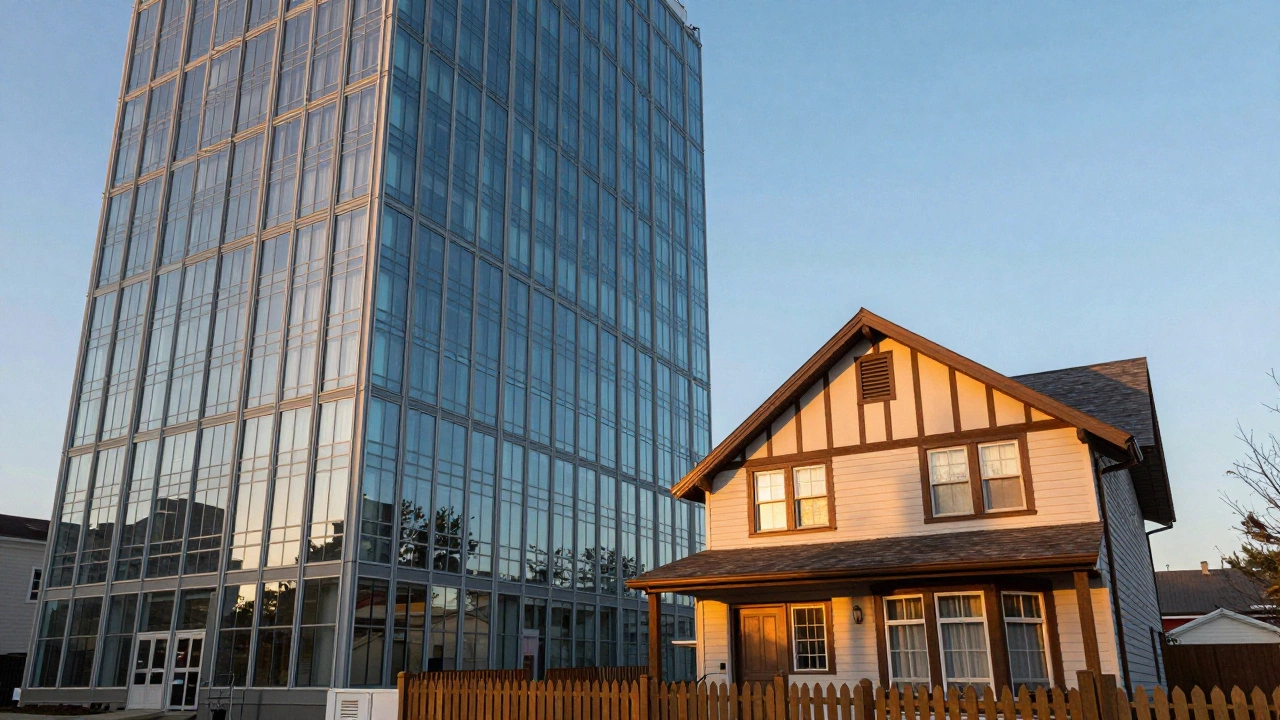
When you walk past a tall glass tower in the city and then turn the corner to see a row of houses with picket fences, you’re seeing two very different worlds of construction. One is built for business, the other for living. At first glance, they might look similar-walls, roofs, windows-but the differences run deep. They’re designed for different purposes, built under different rules, and even use different materials. If you’re trying to understand why a warehouse looks nothing like a suburban home, or why a retail store has wider hallways than a two-bedroom apartment, you’re asking the right question.
Purpose Drives Design
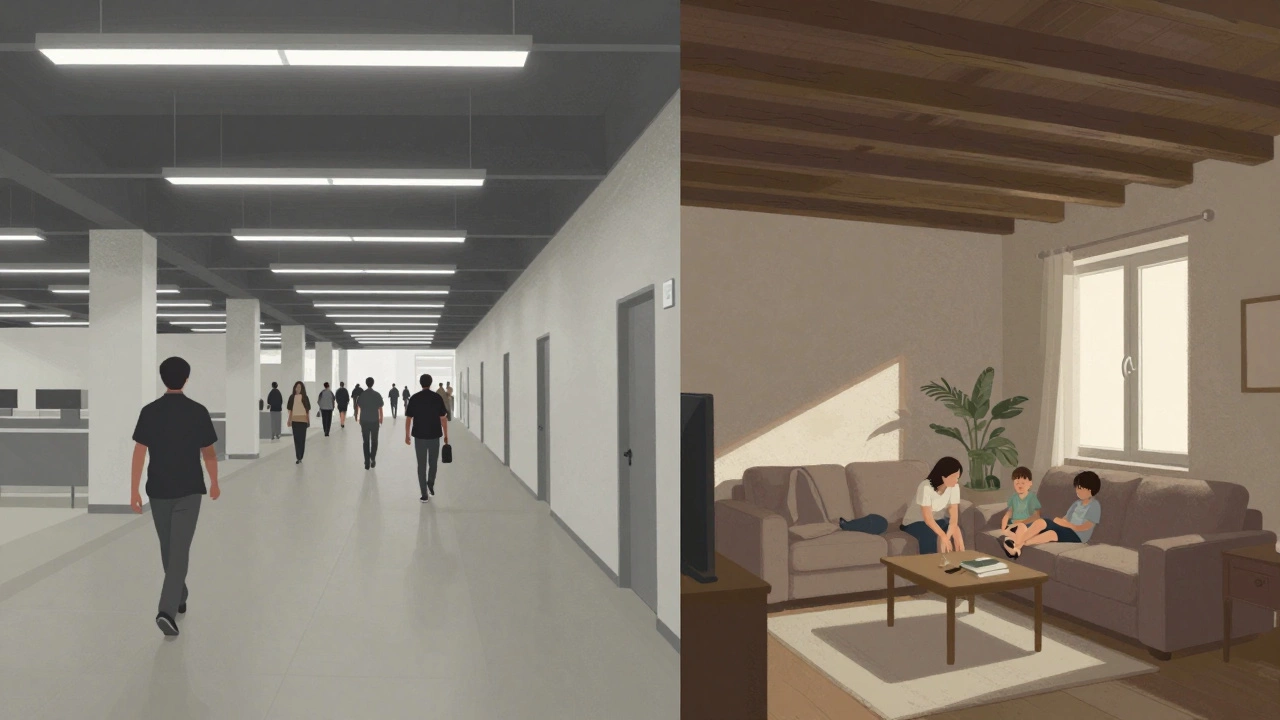
Commercial buildings exist to make money. They’re spaces where people work, shop, eat, or receive services. Think offices, hotels, hospitals, restaurants, and warehouses. Their design prioritizes efficiency, traffic flow, and durability under heavy use. A single office building might house 500 employees who come and go all day, every day. That means elevators need to move fast, restrooms must handle high volume, and HVAC systems need to run nonstop.
Residential buildings, on the other hand, are built for comfort and privacy. They’re homes-apartments, townhouses, single-family houses-where people sleep, eat, relax, and raise families. The focus isn’t on how many people pass through in a day, but on how well the space supports daily life. A bedroom doesn’t need to accommodate 20 people at once. A kitchen doesn’t need to serve 100 meals an hour. That changes everything about layout, materials, and even noise insulation.
Building Codes Are Not the Same
You might think all buildings follow the same rules. They don’t. Commercial buildings in Australia are governed by the Building Code of Australia (BCA), specifically Volume Two for commercial use. These codes demand higher fire safety standards, more emergency exits, stronger structural supports, and stricter accessibility rules. For example, a commercial building over a certain size must have sprinkler systems, fire-rated walls, and exit signs that glow even during a power outage.
Residential buildings follow different parts of the same code, but the requirements are lighter. A house might only need one or two exits, smoke alarms instead of full fire suppression systems, and stairways that meet basic safety thresholds. The goal isn’t to handle mass evacuations-it’s to protect a few people in a quiet, controlled environment.
Materials and Construction Methods Differ
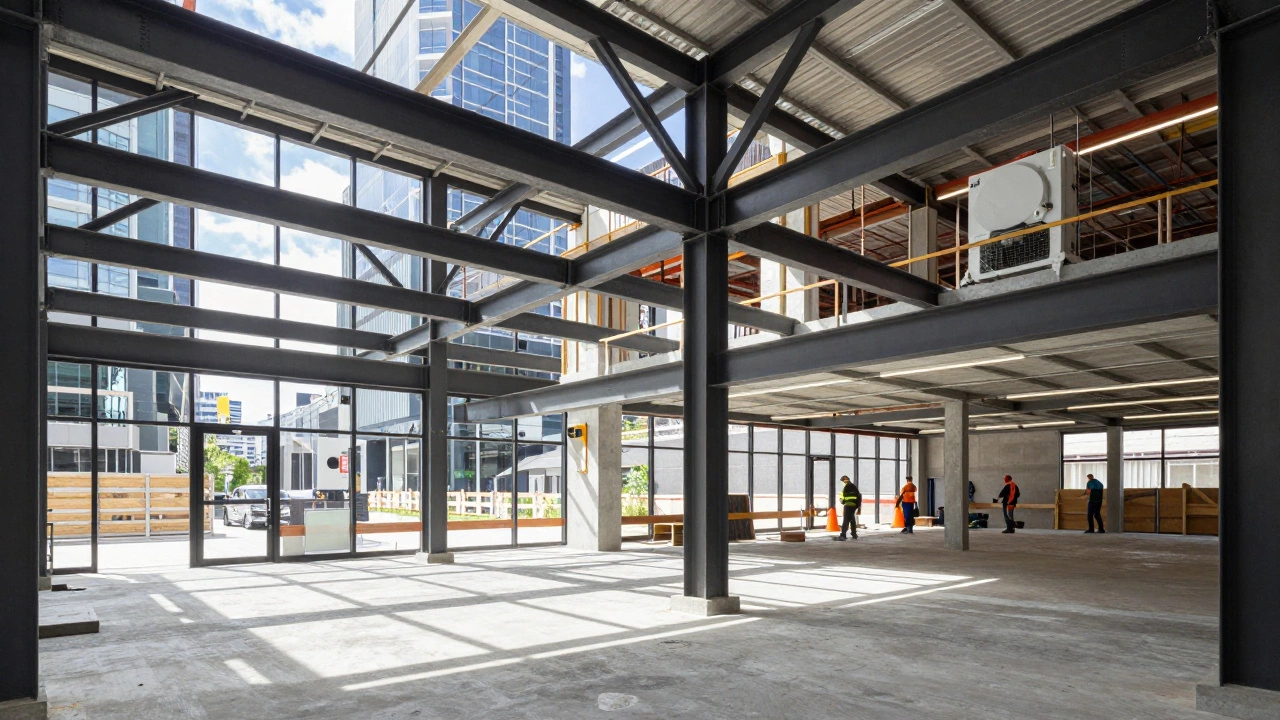
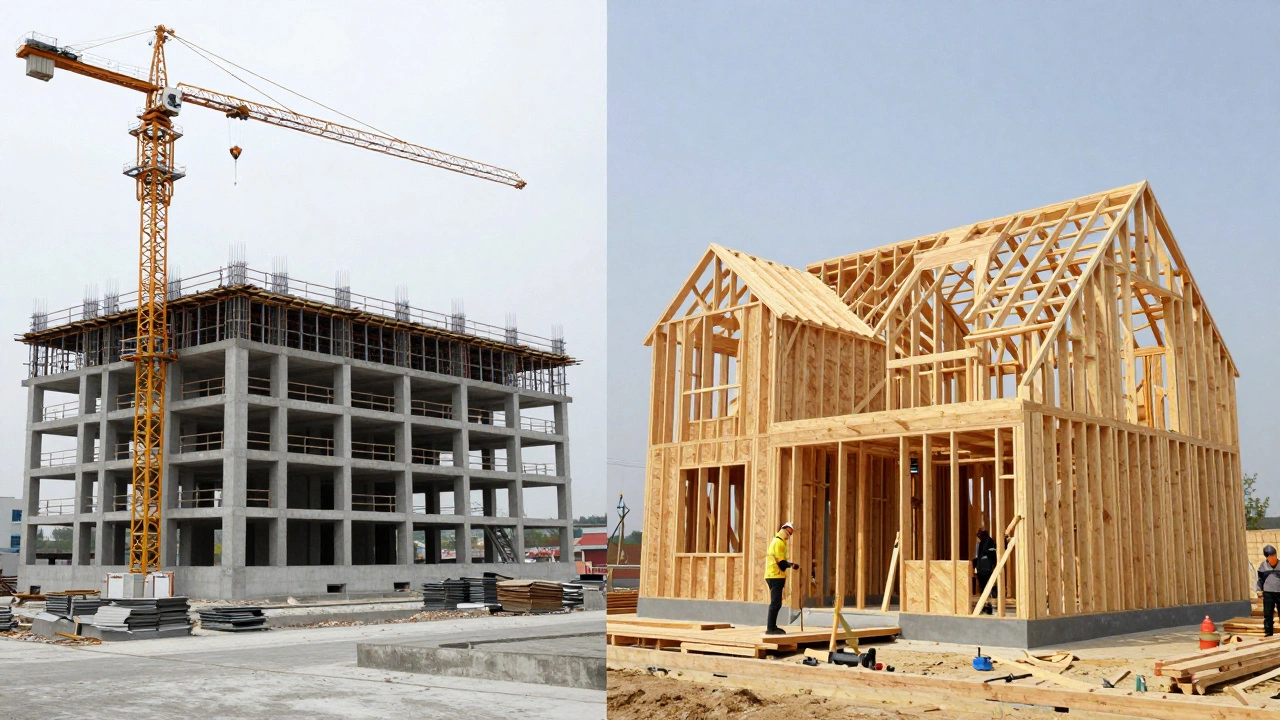
Commercial buildings often use steel frames, concrete slabs, and curtain wall systems. Why? Because they need to support heavy loads-think large HVAC units, dense office equipment, or stacked inventory in a warehouse. Steel can span long distances without needing interior columns, giving businesses open floor plans that are flexible for tenants. A retail store doesn’t want to bump into support beams every time they rearrange displays.
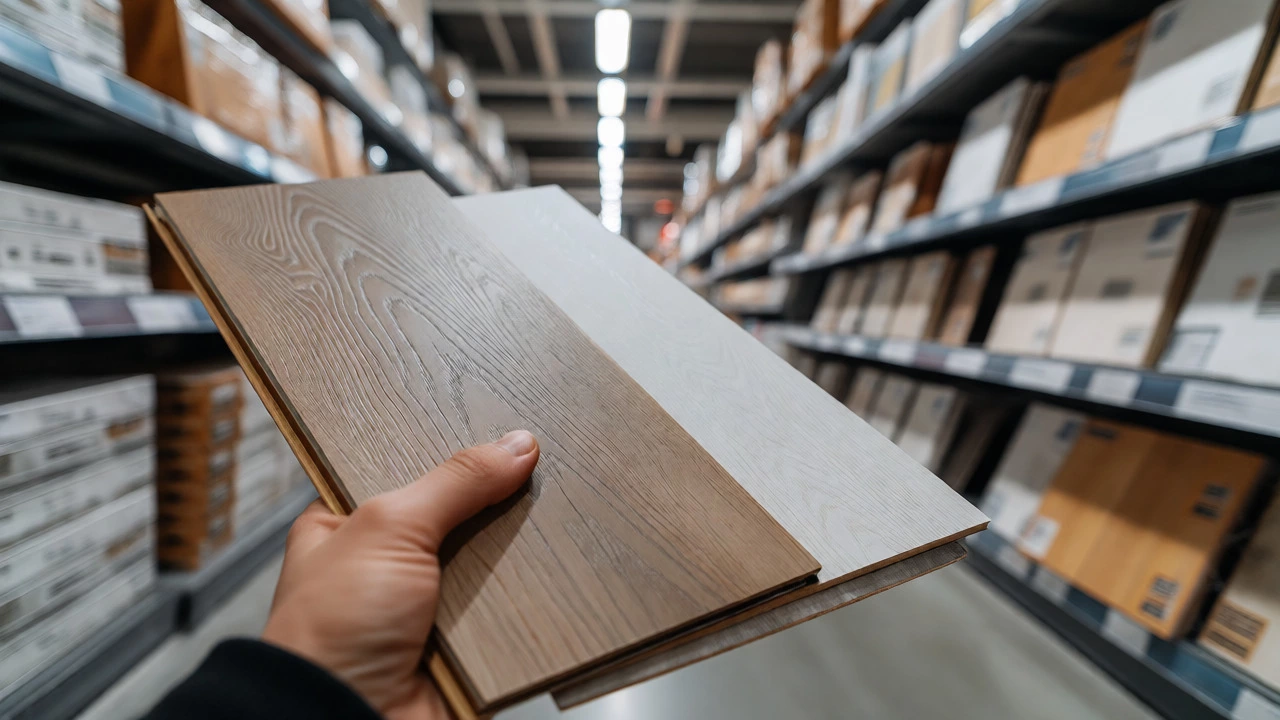
Residential buildings mostly use wood framing. It’s cheaper, easier to work with, and perfectly suited for smaller, lighter structures. A two-story house doesn’t need the same load-bearing strength as a 10-story office tower. Wood framing also allows for faster construction and easier modifications-like adding a new window or knocking down a non-load-bearing wall. You won’t find steel beams in your neighbor’s backyard shed, but you’ll see them in every new shopping center.
Size and Scale Are Worlds Apart
Commercial buildings are almost always larger. Even a small retail shop is often 1,000 square meters or more. Office towers can be 30,000 square meters or more. They’re built to maximize usable space per square meter. That’s why you see open-plan layouts, shared bathrooms, and minimal interior walls.
Residential buildings are measured in square meters per person. A typical Australian home is around 200-250 square meters for a family of four. That’s roughly 50-60 square meters per person. Commercial spaces don’t care about personal space-they care about revenue per square meter. A coffee shop might fit 20 customers in 40 square meters. That’s density you’d never see in a home.
Accessibility and Safety Requirements
Commercial buildings must comply with the Disability Discrimination Act and the Australian Standard AS 1428.1 for accessible design. That means wider doorways (at least 900mm), ramps instead of stairs, accessible restrooms with grab bars and turning space, and elevators that can accommodate wheelchairs and stretchers. These aren’t optional. A business that doesn’t meet these standards can be sued.
Residential buildings have some accessibility requirements too, but they’re far less strict. A new home might need a step-free entry, but it doesn’t need a full accessible bathroom unless it’s part of a multi-unit complex. The focus is on basic safety, not universal access.
Energy Use and HVAC Systems
Commercial buildings use way more energy. A typical office building runs HVAC 24/7, 365 days a year. Lights stay on after hours. Servers hum in data closets. Elevators move constantly. That’s why commercial buildings need high-efficiency systems, smart thermostats, and often solar panels or energy recovery ventilators. Many cities now require commercial buildings to report their energy use annually.
Residential buildings are much more variable. People turn off lights, adjust thermostats, and unplug devices. A home might use 10-15 kilowatt-hours per day. A small office building can use 10 times that. That’s why commercial HVAC systems are built for endurance, not comfort alone.
Cost and Construction Time
Building a commercial structure is almost always more expensive. Why? Higher material standards, more complex engineering, longer permitting, and stricter inspections. A 5,000-square-meter office building might cost $3,000 per square meter. That’s $15 million just to build the shell. A similar-sized residential apartment block might cost $2,500 per square meter-but that’s spread across 50 units. Per person, it’s cheaper. Per square meter, it’s less intensive.
Construction time reflects this too. A single-family home might take 6-8 months. A commercial building of similar size? Often 12-18 months. More approvals, more trades working in sequence, more safety checks. Delays are common, and they’re costly.
Who Owns and Maintains Them?
Residential buildings are usually owned by individuals or property investors. Maintenance is personal-fix a leaky tap, repaint a room, replace a broken fence. It’s reactive and often done by the owner.
Commercial buildings are owned by corporations, property trusts, or government bodies. Maintenance is a business function. There are contracts with cleaning crews, HVAC technicians, security firms, and waste removal services. A shopping center might have a full-time facilities manager. A hospital has maintenance teams on call 24/7. It’s not about fixing things when they break-it’s about preventing them from breaking.
Why This Matters to You
Even if you’re not in construction, understanding these differences helps. If you’re renting a space for your business, knowing why the ceiling height is 4.5 meters instead of 2.4 meters explains why your office feels so open. If you’re buying a home, understanding why the walls are thinner than in a commercial building helps explain why you hear your neighbor’s TV. It’s not a flaw-it’s by design.
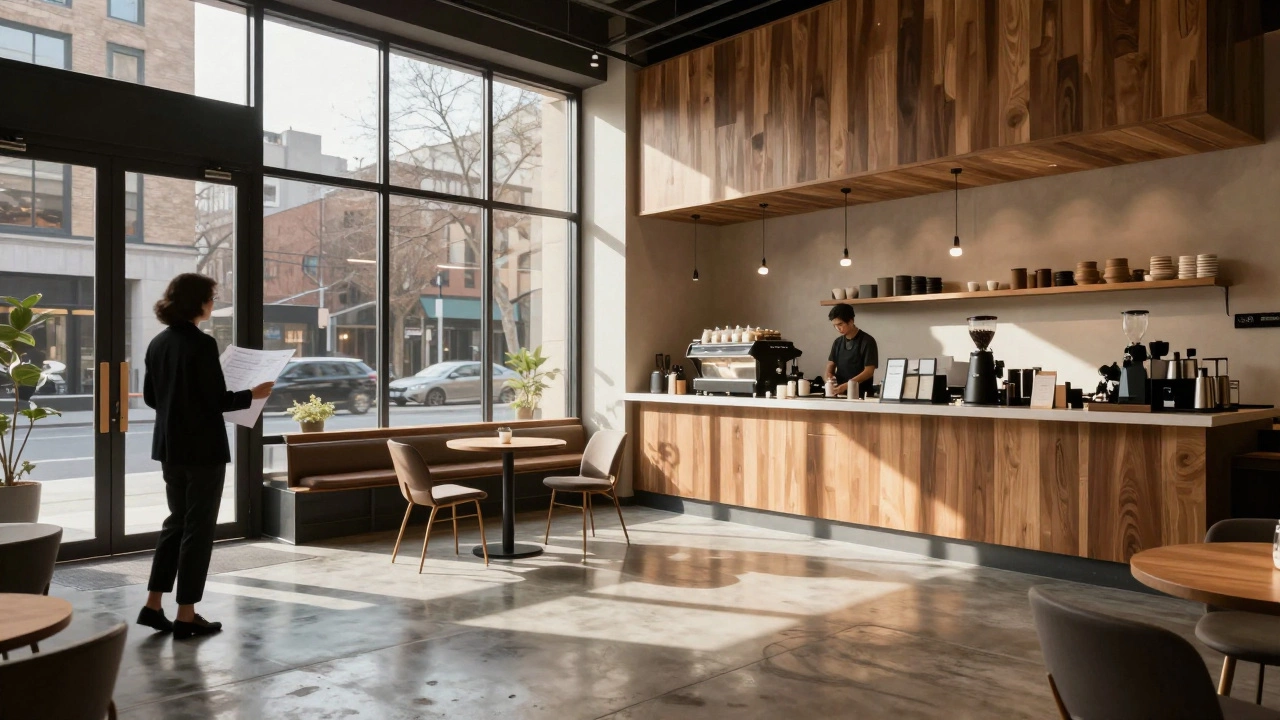
And if you ever think about renovating, the rules change completely depending on whether you’re turning a garage into a home office or a basement into a café. One might need a permit. The other might need a structural engineer, a fire safety report, and a health department inspection.
| Feature | Commercial Buildings | Residential Buildings |
|---|---|---|
| Primary Purpose | Business operations, revenue generation | Living, comfort, privacy |
| Building Code | BCA Volume Two, strict fire and safety | BCA Volume One, lighter requirements |
| Structural Material | Steel, concrete, curtain walls | Wood framing, lightweight construction |
| Typical Size | 1,000-50,000+ sqm | 100-300 sqm (per dwelling) |
| Accessibility | Mandatory universal access (AS 1428.1) | Basic access only, not always required |
| Energy Use | High, 24/7 operation | Low, intermittent use |
| Construction Time | 12-18 months | 6-8 months |
| Maintenance | Professional, scheduled, contract-based | Owner-managed, reactive |
Common Misconceptions
One myth is that commercial buildings are always taller. Not true. Many warehouses are single-story. Some luxury homes are five stories high. Height isn’t the divider-use is.
Another myth is that residential buildings are safer. In fact, commercial buildings have far more safety systems because they’re designed for emergencies involving hundreds of people. A house might have one smoke alarm. A shopping mall has dozens-connected to a central alarm system, with backup power, and regular testing.
People also assume that residential materials are better quality. But that’s backwards. Commercial buildings use industrial-grade materials because they’re built to last under constant stress. A commercial-grade door handle might last 200,000 cycles. A residential one? 50,000. The commercial one is stronger-not fancier.
Can you live in a commercial building?
In most cases, no. Commercial buildings are zoned for business use only. Living in one without approval can violate local planning laws. Some cities allow mixed-use buildings-like apartments above shops-but those are designed from the start to meet both residential and commercial codes. You can’t just move into an empty office space and call it home.
Why do commercial buildings have higher ceilings?
Higher ceilings-often 3.5 to 4.5 meters-allow for better airflow, accommodate large HVAC ducts, and create a sense of openness for customers and workers. They also make it easier to install lighting grids and signage. In residential buildings, ceilings are usually 2.4 to 2.7 meters because they’re designed for human scale, not mechanical systems.
Are commercial buildings more expensive to maintain?
Yes, often significantly. Commercial buildings require constant upkeep: cleaning, security, HVAC servicing, fire system checks, and elevator maintenance. A single office tower might spend $500,000 a year on maintenance alone. A similar-sized residential building might spend $100,000. The difference comes from scale, usage, and legal requirements.
Do residential buildings have to meet fire safety codes?
Yes, but less strictly. Residential buildings must have smoke alarms, fire-rated doors in some cases, and escape routes. But they don’t need sprinklers unless they’re over three stories or part of a large complex. Commercial buildings must have full fire suppression systems, fire-rated walls, and emergency lighting-because they’re designed to hold hundreds of people during an emergency.
Can you convert a commercial building into a home?
It’s possible, but it’s a major renovation. You’d need to add kitchens, bathrooms, insulation, and residential-grade electrical systems. You’d also need to meet residential building codes, which might mean lowering ceiling heights, adding windows for natural light, and reducing structural load capacity. Many conversions fail because the original structure wasn’t built for living-steel frames don’t insulate well, and concrete floors are cold and noisy.
Final Thought
At the end of the day, commercial and residential buildings aren’t just different in size or shape-they’re built for entirely different human experiences. One is a machine for productivity. The other is a sanctuary for life. You can’t swap them without changing the rules, the materials, and the very purpose of the space. Understanding that helps you make smarter choices-whether you’re renting, renovating, or just wondering why your office building feels so different from your apartment.