
Kitchen Efficiency Audit Tool
Discover which parts of your kitchen are wasting time and how to fix them.
Select the appliances/tools you use at least once a week. These are your "Critical Few."
Which zones do you want to prioritize? Click to select up to 3 high-priority zones.
Near Sink
Near Stove
Morning Routine
Kid-Friendly
Sink/Dishwasher
Dry Goods
Your Kitchen Profile
Recommended Actions
Zone Strategy
You know that feeling when you spend twenty minutes hunting for the good knives while your pasta boils over? Or when you’re doing a weird dance around the island just to get from the fridge to the stove? It’s frustrating. And honestly, it’s usually bad design, not bad luck.
Most people think kitchen renovation is about picking pretty tiles or the trendiest faucet. But if you ask any professional chef or experienced renovator, they’ll tell you the truth: kitchen efficiency beats aesthetics every single time. That’s where the 80/20 rule comes in. It’s not just business jargon; it’s a powerful tool for making your cooking life easier.
Why Your Current Kitchen Layout Might Be Failing You
Let’s be real. Most kitchens are designed by committee or by whoever signed the building permit, not by the person actually cooking dinner at 6 PM on a Tuesday. The result? A layout that looks great in photos but makes you want to order takeout.
Think about your morning coffee routine. Do you have to walk three steps to the kettle, two steps to the mug cupboard, and then another step to the counter to pour? Multiply those tiny movements by 365 days a year. That’s wasted energy. The 80/20 rule suggests that if you streamline these high-frequency actions, you save massive amounts of time and mental load.
In Melbourne, where we love our outdoor living and integrated kitchens, this is even more critical. We often have open-plan spaces where the kitchen is the hub. If the hub is inefficient, the whole house feels disjointed. You aren’t just designing a room; you’re designing a workflow.
Identifying Your Critical 20%
So, how do you find that magical 20%? It’s not about guessing. It’s about observation. For one week, pay attention to what you actually touch and use. Not what you *think* you should use, but what you *do* use.
- Appliances: Do you really use the blender weekly? Or is it the toaster and the kettle?
- Tools: Are there twelve spatulas in the drawer, but you only reach for the silicone one?
- Zones: Where do you spend most of your time? Is it near the sink for prep? Near the oven for baking?
You’ll likely find that a handful of items dominate your usage. Maybe it’s your stand mixer because you bake bread on weekends. Maybe it’s your air fryer because you’re busy during the week. These are your "critical few." Everything else is noise. Once you identify them, your job is simple: give them prime real estate.
Optimizing the Work Triangle vs. The Work Zones
Old-school design taught us the "Work Triangle"-connecting the fridge, sink, and stove. While still useful, it’s a bit rigid for modern Australian homes. The 80/20 approach favors "Work Zones." This method groups items by task, not just appliance type.
| Feature | Traditional Work Triangle | 80/20 Work Zones |
|---|---|---|
| Focus | Distance between three major appliances | Grouping tools and ingredients by task |
| Flexibility | Rigid; hard to change later | High; adapts to user habits |
| Efficiency | Reduces walking distance | Reduces cognitive load and movement |
| Best For | Small, galley-style kitchens | Open-plan, multi-cook households |
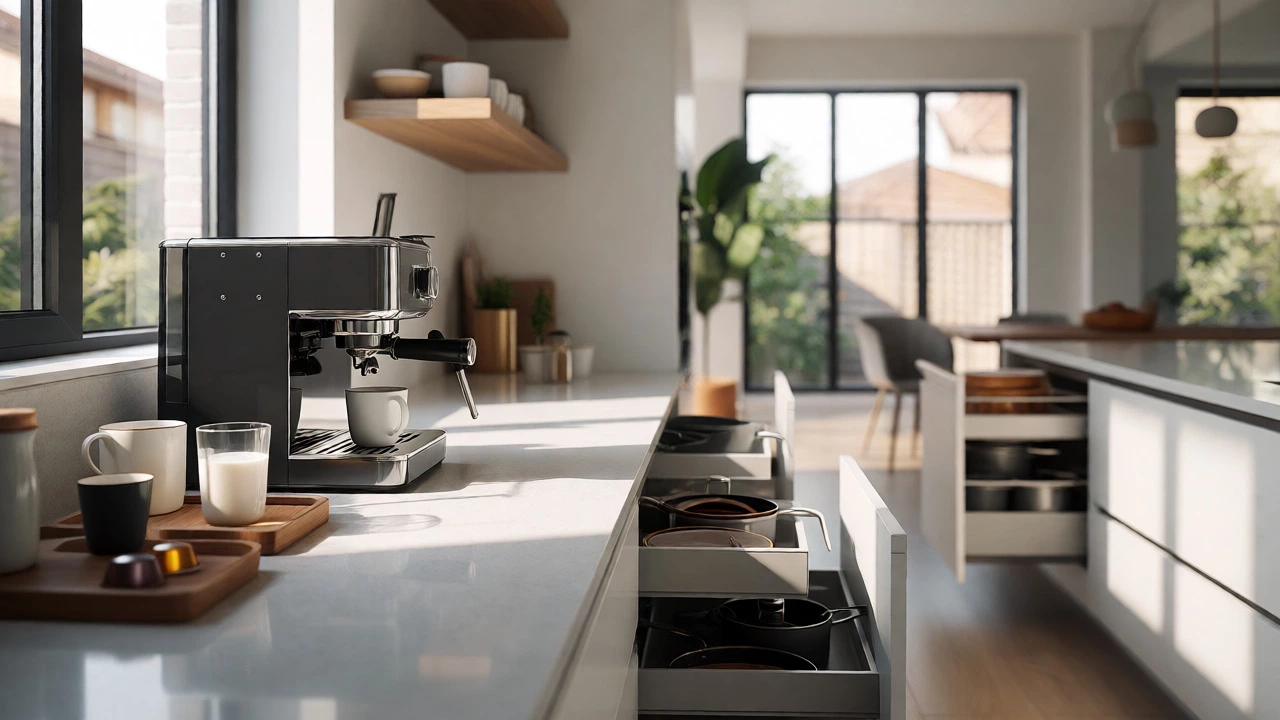
For example, create a "Coffee Zone." Put the machine, mugs, pods, sugar, and milk fridge access within arm’s reach. Don’t make yourself open three different cupboards. Similarly, build a "Prep Zone" right next to the sink. Keep your cutting boards, knives, and peeler there. If you chop veggies in one spot and store them in another, you’re fighting the 80/20 rule.
Storage Solutions That Respect the Ratio
Clutter is the enemy of efficiency. If you have to dig through a pile of plastic containers to find the one with the matching lid, you’ve failed the 80/20 test. The goal is zero-search storage.
Here is a practical heuristic: Anything you use daily goes in the "Golden Zone." This is the area between your waist and eye level. It requires no bending and no reaching. Items used monthly can go higher up or lower down. Seasonal items (like the Christmas cookie cutters or the turkey roaster) belong in the garage or a high pantry shelf.
Consider deep drawers instead of shelves for pots and pans. Shelves force you to kneel and rummage. Drawers bring everything out to you. Yes, they cost more upfront. But if they save you five seconds every time you cook, they pay for themselves in sanity before the year is out.
Lighting and Surfaces: The Invisible 20%
We often forget lighting when thinking about function. But poor lighting slows you down. If you can’t see the color of the meat searing in the pan, you hesitate. Hesitation kills flow.
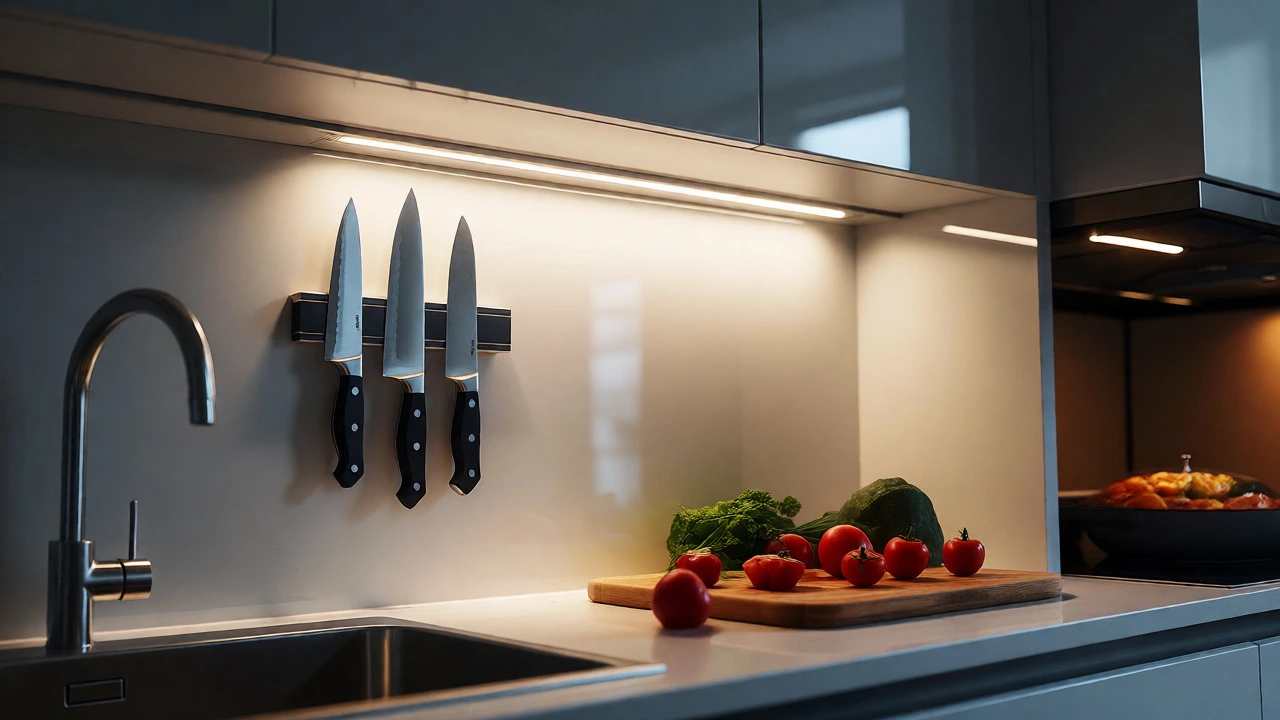
Apply the 80/20 rule here too. You don’t need chandeliers everywhere. You need bright, shadow-free light on your primary work surfaces-the benchtop near the sink and the stove. Under-cabinet LED strips are cheap, easy to install, and instantly boost functionality. They highlight the 20% of the kitchen where 80% of the action happens.
Same goes for benchtops. Choose durable materials like quartz or stainless steel if you cook heavily. If you’re mostly reheating leftovers, laminate might suffice. Match the material to the usage intensity. Don’t overspend on durability you won’t use, and don’t underspend on surfaces that take a beating.
Common Pitfalls When Applying the Rule
It’s tempting to buy every gadget that promises to save time. The spiralizer! The sous-vide stick! The smart fridge! But remember: if you use it once a month, it’s part of the 80% clutter, not the 20% essential.
Another trap is ignoring the "landing zone." This is the empty space next to the oven or microwave. You need somewhere to put hot dishes immediately. If you skip this to save cabinet space, you end up clearing off half the counter every time you cook. That small 10cm gap is worth its weight in gold.
Also, don’t underestimate vertical space. Magnetic knife strips free up drawer space. Wall-mounted rails hold frequently used utensils. By moving the critical 20% out of drawers and onto walls, you keep the rest of the kitchen calm and organized.
Real-World Example: The Melbourne Family Kitchen
Imagine a typical suburban home in Footscray. The family cooks together on weekends. The parents use the oven and stove daily. The kids grab snacks from the pantry.
To apply the 80/20 rule, the designer creates a dedicated snack zone at kid-height. Low drawers with healthy options, a water dispenser, and easy-access cups. This stops the kids from raiding the main cabinets. Meanwhile, the adults’ cooking zone has a pull-out spice rack right next to the stove and a waste bin under the prep area. No one walks across the room to throw away peelings. The workflow is seamless because it was designed around actual human behavior, not idealized magazine layouts.
This isn’t about luxury. It’s about logic. It’s about respecting your time. When your kitchen works for you, you cook more. You eat better. You stress less. That’s the real payoff.
Does the 80/20 rule apply to small kitchens?
Absolutely. In fact, it’s even more crucial in small spaces. With limited square footage, every centimeter counts. By identifying the 20% of items you use most, you can dedicate specific, accessible spots for them, preventing the "clutter avalanche" that makes tiny kitchens feel chaotic. Vertical storage becomes your best friend here.
How do I decide which appliances stay on the bench?
Use the "weekly touch" test. If you touch an appliance at least once a week, it stays on the bench or in the Golden Zone. If you haven’t touched it in a month, it goes into a cupboard or the pantry. Exceptions exist for sentimental items, but be honest with yourself. A bread maker gathering dust is just expensive furniture.
Is the work triangle obsolete?
Not obsolete, but evolved. The traditional triangle assumes one cook and a closed kitchen. Modern open-plan homes often have multiple cooks and islands. The 80/20 approach shifts focus from geometric distance to functional grouping (zones). The triangle is still a good baseline for safety and basic flow, but zones optimize for speed and ease.
Can I apply this to an existing kitchen without renovating?
Yes, definitely. Start by decluttering. Remove anything you don’t use weekly. Then, rearrange your current storage. Move your most-used items to the easiest-to-reach shelves and drawers. Install under-cabinet lighting. Add hooks for frequent-use tools. These low-cost changes can dramatically improve efficiency without touching the cabinetry.
What about guests who help cook?
Designate a "guest zone." Keep basic utensils, plates, and drinks in a separate, accessible area so helpers don’t interfere with your main workflow. This keeps your critical 20% clear for the primary cook, reducing bottlenecks when friends or family are helping out.