Ever hung a picture only to step back and feel like something’s just… off? It’s not your eyes. It’s probably the height. Most people hang art too high. That’s where the 2/3 rule comes in - a simple, proven method to make your wall art look intentional, balanced, and professionally done.
What Exactly Is the 2/3 Rule?
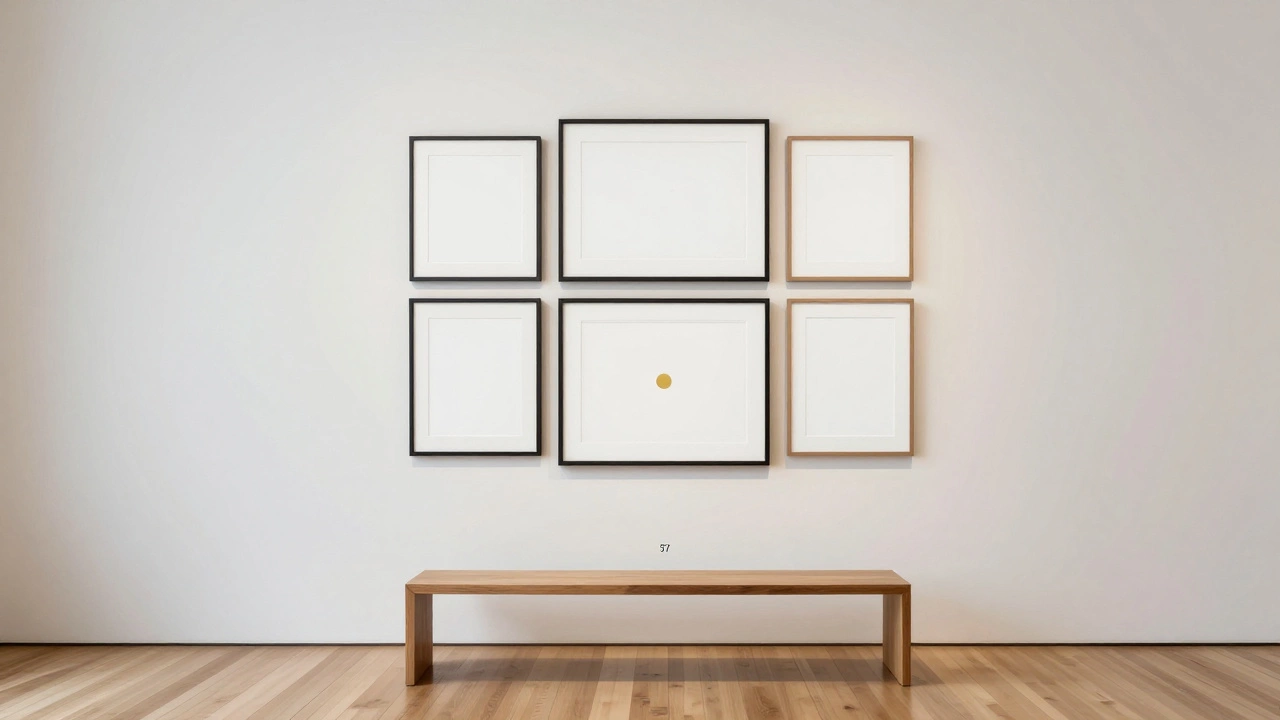
The 2/3 rule for hanging pictures says: position the center of your artwork at about two-thirds the height of the wall from the floor. In most homes, that lands between 57 and 60 inches (145-152 cm) above the floor. This isn’t random. It’s based on average human eye level - the spot where your gaze naturally rests when standing in a room.Think of it this way: if you walked into your living room barefoot, where would your eyes land first? Not at ceiling height. Not at the baseboard. Somewhere just above the couch, where you’d naturally look while chatting or relaxing. That’s the sweet spot. The 2/3 rule gives you a consistent target so your art doesn’t look like it was thrown up after a late-night binge-watching session.
Why 57-60 Inches? It’s Not Arbitrary
Museums have been using this standard for over a century. The American Museum Directors Association officially adopted 57 inches as the standard center height for gallery displays in the 1930s. Why? Because it matches the average eye level of an adult standing upright. When you hang art at this height, it feels natural - like the piece was meant to be there.Even if your ceiling is 10 feet high or your couch is extra low, stick to that 57-60 inch range. Your art won’t disappear into the wall, and it won’t look like it’s floating in space. It’ll feel grounded. This rule works whether you’re hanging a single large canvas, a gallery wall, or a small framed photo.
What If You’re Hanging Art Above Furniture?
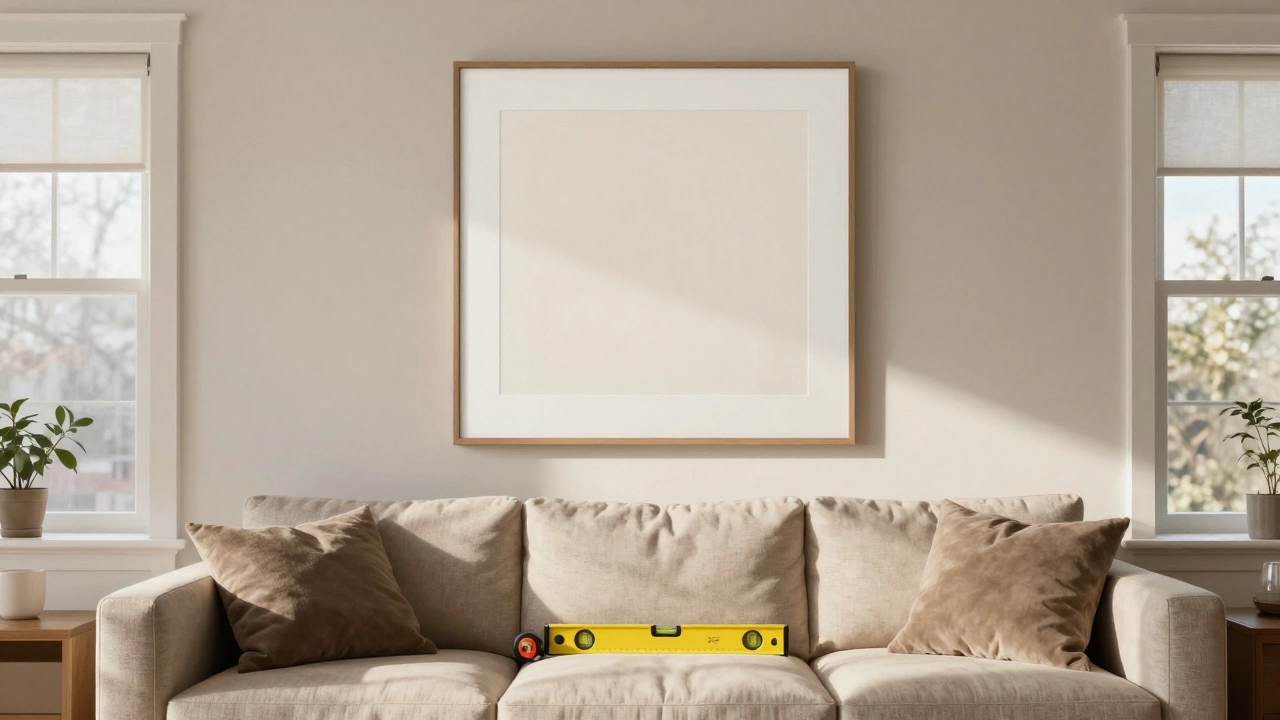
This is where people get confused. You see a sofa, a console table, or a bed - and you think, “The art should be centered above it.” That’s partially right, but only if you’re also following the 2/3 rule.Here’s the real trick: the bottom edge of your artwork should be 6 to 8 inches above the top of your furniture. That gap gives the piece breathing room. Too close, and it looks stuck. Too far, and it feels disconnected.
So if your sofa is 18 inches tall, the bottom of your frame should sit around 24 to 26 inches above the floor. That puts the center of a 24-inch-tall artwork at roughly 36-37 inches - way too low. That’s why you can’t just measure from the furniture. You still need the center of the piece to land at 57-60 inches. If your art is tall, that gap above the sofa might be more than 8 inches. If it’s small, you might need to hang it a little lower. The center is king.
How to Measure It Right (No Guessing)
Forget eyeballing it. Use a tape measure and a level. Here’s how to get it perfect:- Measure the height of your artwork. Let’s say it’s 24 inches.
- Divide that by two: 24 ÷ 2 = 12 inches. That’s the distance from the bottom of the frame to its center.
- Subtract that from your target height: 57 inches - 12 inches = 45 inches.
- Measure up 45 inches from the floor and mark the spot.
- Hold your hanging hardware (wire, D-ring, sawtooth hanger) against the wall at that mark.
- Use a level to make sure your line is straight before you drill.
Pro tip: If you’re using a nail or picture hook, remember the hook sits below the mark. So if your hook is 1 inch below the top of the frame, subtract that extra inch. You’re measuring from the floor to the point where the wire will hang - not the center of the frame.
Gallery Walls and Multiple Pieces
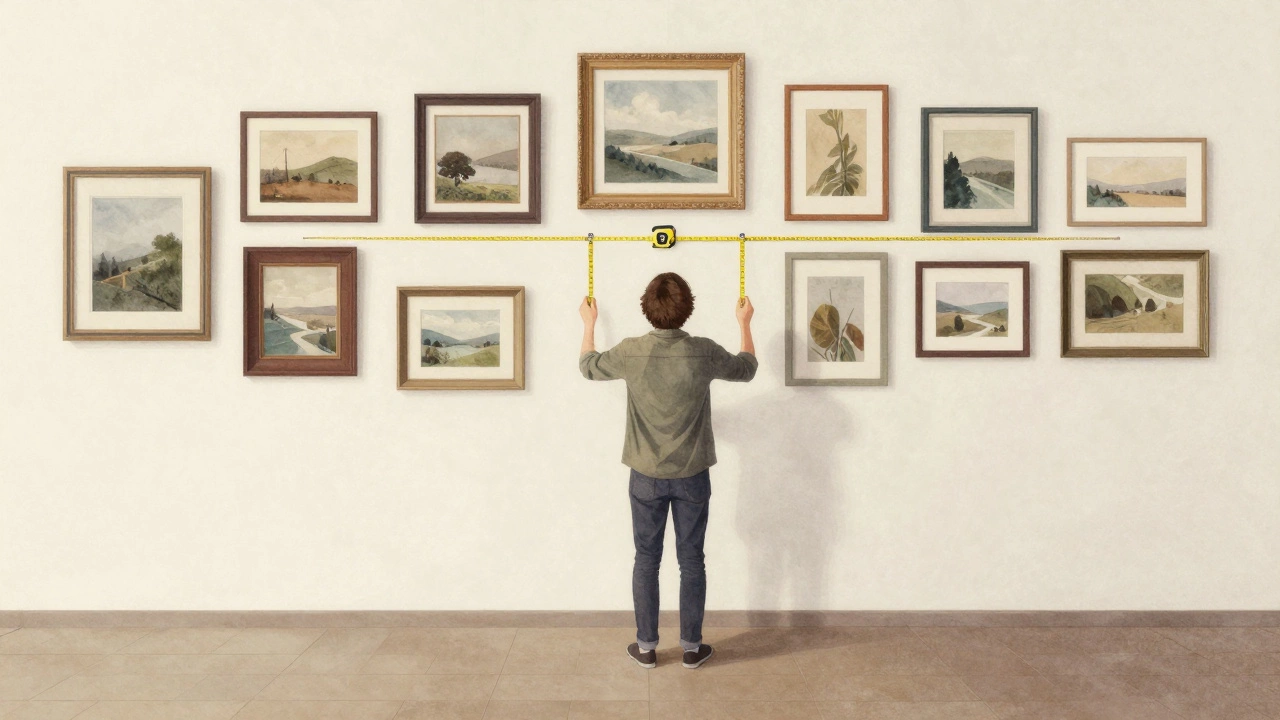
The 2/3 rule still applies, but now you’re working with a group. Don’t treat each piece individually. Treat the whole cluster as one large shape.Find the center of your entire arrangement. Is it a 5-piece grid? A vertical stack? A diagonal line? Measure the total height of the group, divide by two, and place that center point at 57-60 inches above the floor. The individual pieces can vary in size, but their collective center should hit that sweet spot.
For example: you’ve got five frames arranged in a 3x2 grid, totaling 36 inches in height. Half of that is 18 inches. So the center of the grid should be at 57 inches. That means the bottom of the lowest frame should be at 57 - 18 = 39 inches above the floor. That’s still above most couches - perfect.
What About High Ceilings or Sloped Walls?
High ceilings don’t change the rule. Even in a 12-foot foyer, your eye still looks out at eye level, not up at the ceiling. Hanging a large painting 8 feet up might look dramatic, but it won’t feel connected to the space. Use the 2/3 rule to anchor the art to the human scale.For sloped walls - like in an attic or loft - the same logic applies. Find the spot where your gaze naturally lands when you’re standing in the room. That’s your target. If the slope makes it hard to hang straight, use a laser level or a plumb line. Your art should feel intentional, not accidental.
Common Mistakes to Avoid
- Hanging too high: Art that’s above 65 inches feels like it’s floating away. It loses connection with the room.
- Hanging too low: Art that’s below 50 inches looks like it’s on the floor or stuck to the wall like a poster.
- Ignoring furniture: Art that’s centered on the wall but 12 inches above the couch looks disconnected. Always keep that 6-8 inch gap.
- Not using a level: Even a 2-degree tilt is noticeable. Your brain picks up on it before you consciously notice.
- Assuming all rooms are the same: In a bedroom, you might hang art a bit lower if you’re mostly sitting up in bed. In a hallway, go with the standard 57-60 inches.
Real-Life Examples
In a Melbourne living room with a 20-inch-high console table and a 30-inch-tall framed print, the bottom of the frame should sit at 26-28 inches. That puts the center at 41-43 inches - too low. So you’d need a taller piece. A 48-inch-tall artwork would have a center at 57 inches if the bottom sits at 33 inches. That’s 13 inches above the console - still within the 6-8 inch rule? No. That’s too far. So you’d either pick a smaller piece or lower the whole thing slightly, accepting that the center is now at 54 inches. That’s close enough. The 2/3 rule is a guide, not a law.Another example: a 60-inch-wide landscape painting over a king-sized bed. The bed is 22 inches tall. The bottom of the frame should be 28-30 inches above the floor. The painting is 40 inches tall, so its center is at 48 inches. That’s too low. You’d need to raise it - even if it’s above the bed. The center should still be at 57 inches. That means the bottom of the frame is at 37 inches - 15 inches above the bed. That’s acceptable. It’s a large piece. It needs space. The eye still finds the center at the right height.
Final Tip: Test It First
Before you make a hole in the wall, hold the artwork up with painter’s tape. Step back. Sit on the couch. Stand in the doorway. Look at it from different angles. Does it feel like it belongs? If it feels like an afterthought, it probably is. Adjust. Move it up or down an inch. That small shift can make all the difference.The 2/3 rule isn’t about perfection. It’s about intention. When your art hangs at the right height, it doesn’t just look good - it feels right. Your room breathes easier. Your eyes feel at home. And that’s what good design is all about.