
Architectural Fee & Overhead Calculator
Input Your Data
Your Pricing Strategy
- Fully Loaded Cost $0.00
- Overhead per Hour $0.00
- Labor + Super $0.00
Project Fee Estimators
Imagine spending six months designing a dream home, only to realize at the end that your fees barely cover your rent. This is the nightmare scenario for many architects who underprice their work. You are not just drawing lines; you are managing risk, coordinating engineers, and ensuring safety compliance. If your pricing model doesn't reflect that value, you will burn out or go bankrupt.
Setting rates for architectural services is the process of determining how much clients pay for design, planning, and construction oversight. It requires balancing market rates with your specific overhead costs. In Melbourne and across Australia, the industry is shifting away from vague estimates toward transparent, structured contracts. Getting this right means the difference between a profitable practice and a stressful hustle.
Understanding Your True Costs Before Quoting
Before you can charge a client, you need to know what it actually costs to keep your doors open. Many new architects make the mistake of calculating their hourly rate based only on their desired salary. This ignores the hidden expenses that eat into profits. You must calculate your fully loaded hourly rate.
This includes your salary, superannuation contributions (which are mandatory in Australia), payroll taxes, software subscriptions like Revit or AutoCAD, insurance premiums, office rent, and utilities. A common rule of thumb is that your direct labor cost should be only about 30% to 40% of the total project fee. The rest covers overhead and profit margin. If you quote $150 an hour but your fully loaded cost is $120, you have almost no room for error. One unexpected site visit or revision request wipes out your profit.
| Cost Category | Typical Percentage of Revenue | Examples |
|---|---|---|
| Direct Labor | 30-40% | Architect salary, assistant wages |
| Overhead | 40-50% | Software, rent, insurance, marketing |
| Profit Margin | 10-20% | Net income for growth/reinvestment |
Knowing these numbers allows you to set a floor price below which you never drop. When a client asks for a discount, you can look at your spreadsheet and see exactly what you would lose. It removes emotion from the negotiation and keeps the business viable.
The Main Pricing Models for Architecture
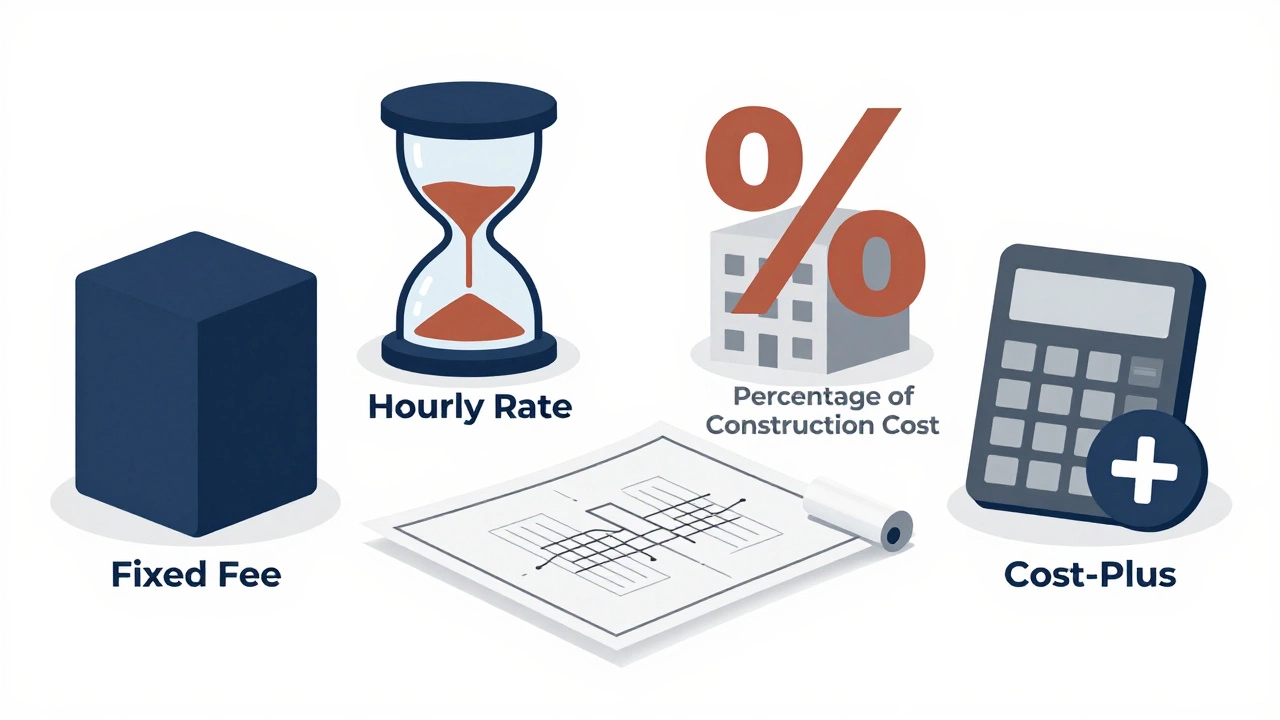
There is no single "correct" way to charge. Different projects suit different models. The most common approaches include fixed fees, hourly rates, percentage of construction cost, and cost-plus fees. Each has distinct advantages and risks depending on the project scope and client type.
Fixed Fee (Lump Sum) is popular because clients love predictability. You agree on a set price for defined deliverables, such as concept design, development approval drawings, and construction documentation. This works well when the scope is clear from the start. However, if the client changes their mind halfway through, you need a robust change order process. Without it, you end up doing extra work for free.
Hourly Rate offers flexibility. You charge for every hour worked. This is ideal for small consultations, feasibility studies, or projects where the scope is undefined. The downside is that efficient work penalizes you. If you get faster at drafting, you earn less. Clients may also worry about runaway costs, so transparency with time logs is essential.
Percentage of Construction Cost ties your fee to the building's budget. Historically, architects charged 10% to 15% of the construction cost. As buildings become more complex, this percentage often drops to 8% to 10%. This model aligns your interests with the client's budget but can be risky if construction costs skyrocket due to inflation or material shortages, potentially capping your earnings while your workload increases.
Cost-Plus Fee involves charging your actual costs plus a markup percentage. This is rare in pure residential work but common in large commercial projects where administrative overhead is high. It guarantees you cover all expenses but requires strict financial tracking and trust from the client.
Factors That Influence Your Rates
Your base rate isn't static. Several variables should adjust your pricing up or down. Location plays a huge role. Working in Melbourne's CBD involves higher overheads than working in regional Victoria, which might justify higher fees. However, local market competition also matters. If everyone nearby charges $100/hour, quoting $200/hour requires a compelling justification of superior value.
Project complexity is another major factor. A simple box-shaped extension is straightforward. A heritage-listed restoration requiring detailed surveys, specialist consultants, and council negotiations is not. You must account for the risk and expertise required. High-risk projects demand higher fees to compensate for potential delays and liability.
Client type also dictates strategy. Private homeowners often have tighter budgets and emotional decision-making processes, leading to more revisions. Commercial developers usually have clearer briefs and larger budgets but expect faster turnaround times. Adjust your terms accordingly. For example, limit the number of revision rounds in residential contracts to protect your time.
Structuring Payments Across Project Phases
Never wait until the end of a project to get paid. Cash flow is the lifeblood of any architectural practice. Structure your contract to align payments with key milestones. This ensures you are compensated for work already completed and reduces the risk of non-payment.
- Pre-Design & Concept: Charge 10-15% upfront. This covers initial meetings, site analysis, and preliminary sketches.
- Schematic Design: Charge 20-25% upon approval of the main design direction. This is when the bulk of creative work happens.
- Development Approval (DA): Charge 20-25% when submission documents are ready. This phase involves significant coordination with planners and authorities.
- Construction Documentation (CD): Charge 25-30% upon completion of technical drawings. This is the most detailed and time-intensive phase.
- Tender & Contract Administration: Charge 10-15% during the building phase. This covers site visits, answering contractor queries, and certifying progress payments.
This phased approach mirrors standard industry practices, such as those outlined by the Australian Institute of Architects (AIA). It provides clear checkpoints for both you and the client. If the project stops after the DA stage, you have already been paid for the work done up to that point.

Negotiating Fees Without Devaluing Your Work
Clients will negotiate. It's part of the business. The key is to negotiate scope, not just price. If a client says your fee is too high, don't immediately lower it. Instead, ask what specifically concerns them. Often, they want fewer deliverables or a simpler design.
Offer tiered packages. A "Basic" package might include only concept design and DA submissions. A "Premium" package adds full construction documentation and site supervision. This gives the client control over their budget while protecting your core revenue. Always document any agreed-upon reductions in writing. Ambiguity leads to disputes later.
Educate your clients on value. Explain that good design saves money during construction by preventing errors and reducing waste. Show examples of past projects where careful planning avoided costly rework. When clients understand that your fee is an investment, not just an expense, they are more willing to pay fair rates.
Common Pitfalls to Avoid
Avoid vague contracts. Specify exactly what is included and, crucially, what is excluded. Does your fee cover engineer fees? Council application fees? Survey costs? Make it clear that these are separate expenses paid directly by the client. This prevents surprise bills and resentment.
Don't ignore intellectual property rights. Your drawings are your assets. Standard contracts should state that you retain copyright until final payment is received. This protects you if a client tries to use your designs without paying. Include clauses for late payment penalties to encourage timely invoices.
Finally, review your rates regularly. Inflation, software updates, and increased experience all justify periodic adjustments. Don't let your fees stagnate while your skills grow. Aim for annual reviews of your pricing structure to ensure it remains competitive and profitable.
What is the average hourly rate for an architect in Australia?
Rates vary widely by location and experience. In Melbourne, junior architects might charge $80-$120 per hour, while senior partners can charge $200-$350+ per hour. Always check current AIA fee guides for localized benchmarks.
Should I charge a fixed fee or hourly rate?
Use fixed fees for well-defined projects where scope is unlikely to change. Use hourly rates for advisory services, consultations, or projects with uncertain outcomes. Hybrid models, where you estimate hours but cap the total, can also work well.
How do I handle change orders?
Include a clear clause in your contract stating that any changes to the approved scope will incur additional fees. Require written approval for changes before proceeding. This protects your time and ensures the client acknowledges the impact on budget and timeline.
Is it legal to charge a percentage of construction cost?
Yes, it is a common and legal pricing model. However, ensure your contract clearly defines how the construction cost is calculated (e.g., excluding GST, land cost, or professional fees) to avoid disputes later.
What if a client refuses to pay the final invoice?
Have a strong contract with retention of title clauses. Send formal demand letters first. If unresolved, consider mediation or small claims court. Preventing this through milestone payments and clear communication is far more effective than chasing debts.